Eli’s gold puzzle egg
Let the Right One InEli’s gold puzzle egg turns a striking ornament into an intricate, deliberately breakable puzzle. When Eli hands it to Oskar, its dark shell, embedded gold threads, and surprising weight invite him to imagine wealth; when it collapses between his hands, he discovers that its real significance lies in the multitude of tiny pieces hidden inside it. The egg makes material fragility visible, and its fragments become part of the physical record of Oskar and Eli’s playful closeness.
Appearance and imagined value
Eli picks up a box shaped like a black egg and gives it to Oskar, who holds it beneath the lamp to inspect it. Its rough surface is worked through with hundreds of complex strands of gold thread. It feels so heavy that Oskar imagines it might be made entirely of metal, and he notices a smell of rust. The combination of black surface, gold detail, weight, and odor makes the object tangible before its purpose is known: it is not simply a precious-looking thing at a distance but something Oskar turns over and examines closely.
Oskar asks what the egg might be worth. Eli says that there are only two in the world and speculates that someone with both could sell them for enough to buy a nuclear power plant, perhaps costing fifty million. The exchange gives the egg an extravagant, almost absurd imagined price, but Eli’s estimates are uncertain rather than a confirmed valuation. Oskar’s question frames the object first as a possible source of money; the subsequent demonstration shifts attention from what it could buy to what it is made to do.
A break that reveals the puzzle
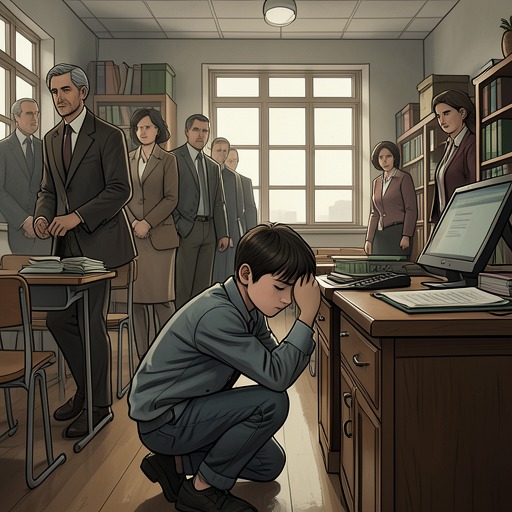
Eli shows Oskar how to hold the egg between cupped hands and let it roll back and forth. Oskar follows the instruction gently, yet feels the egg crack and collapse between his palms. He reacts with alarm and apologizes, believing he has broken it by being careless. Eli reassures him that this is what is supposed to happen and tells him to keep the pieces from falling and pour them onto a sheet of white paper on the table.
The collapse is not damage but the object’s intended operation. The shell becomes hundreds—then thousands—of tiny slivers, which Oskar carefully transfers from his hand. The scene changes the meaning of the egg through a physical reversal: what first seemed a solid, valuable ornament proves to be an assembly of minute parts. Oskar must relinquish the intact-looking whole before he can see the construction concealed within it.
The structure of the pieces
Under the lamp, Eli concentrates the dim light on the heap of fragments. Oskar notices one piece lying apart from the rest. It is no bigger than a tick, but close inspection reveals indentations and notches along some sides and nearly microscopic, light-bulb-shaped protrusions along others. Oskar recognizes that the egg is a puzzle, and Eli confirms it. The revelation depends on attention at a smaller scale: the object’s meaning is not legible in its intact exterior, or even in the heap as a whole, but in the particular shape of an individual fragment.
Other pieces spread beside the pile seem identical at first, yet their notches occupy subtly different positions and their protrusions turn at different angles. Oskar also finds a piece that is smooth-sided apart from a gold border scarcely wider than a hair: a fragment of the outside. The fragments thus preserve both the egg’s inner complexity and traces of its external surface. Its elaborate design is suggested by variations too small to notice at a glance, rather than explained by a completed reconstruction.
Oskar understands that putting the pieces together must take a very long time and says the task would drive him crazy. The egg’s value is consequently recast once more. Its rarity and imagined price belong to the conversation, while its visible challenge lies in the precision and patience required to make a whole from pieces that are nearly alike but not interchangeable. The evidence shows Oskar recognizing that difficulty; it does not show him completing the puzzle.
Fragments in the shared space
Later, as Oskar and Eli wrestle on the couch, they move with concentration but take care not to hurt each other. They bump against the table, and pieces of the black egg fall to the floor with a sound compared to raindrops striking a metal roof. The egg’s fragments have returned to the scene not as an orderly puzzle laid out for examination but as small pieces displaced during play.
That recurrence links the egg’s designed breakability to the ease with which its pieces can scatter in the ordinary movement of Oskar and Eli’s time together. Earlier, Oskar’s careful handling seemed to cause the collapse, only for Eli to explain that breaking the shell was necessary. Later, the fragments fall amid mutual play, without a new explanation of what will happen to them. The object therefore remains both puzzle and vulnerable material presence: its intricate construction invites close attention, while its tiny pieces can be knocked out of place as the children turn their attention from the table to each other.